
Which Schema Types Actually Get Your Site Cited by AI Search?
Only a few schema types actually influence AI citations — here's which ones matter, which ones (like FAQPage) have lost their edge, and what to prioritize instead.
Structured data helps AI search engines by giving them a machine-readable summary of what's on a page, but only a handful of schema types reliably influence whether ChatGPT, Perplexity, or Google AI Overviews cite you. Organization, Article, Product, and FAQPage schema tend to matter most — and even then, schema is a supporting signal, not the thing that gets you cited. Clear, well-structured prose does the heavy lifting.
I've audited a lot of sites over the past year where the owner swore by their schema markup — perfect JSON-LD, validated in Google's Rich Results Test, zero errors. And their AI visibility was still flat. Meanwhile I've seen scrappy blogs with almost no structured data get quoted verbatim in an AI Overview because the content itself was written in a way a language model could lift and reuse. That gap is the whole point of this post.
What does structured data actually do for AI search?
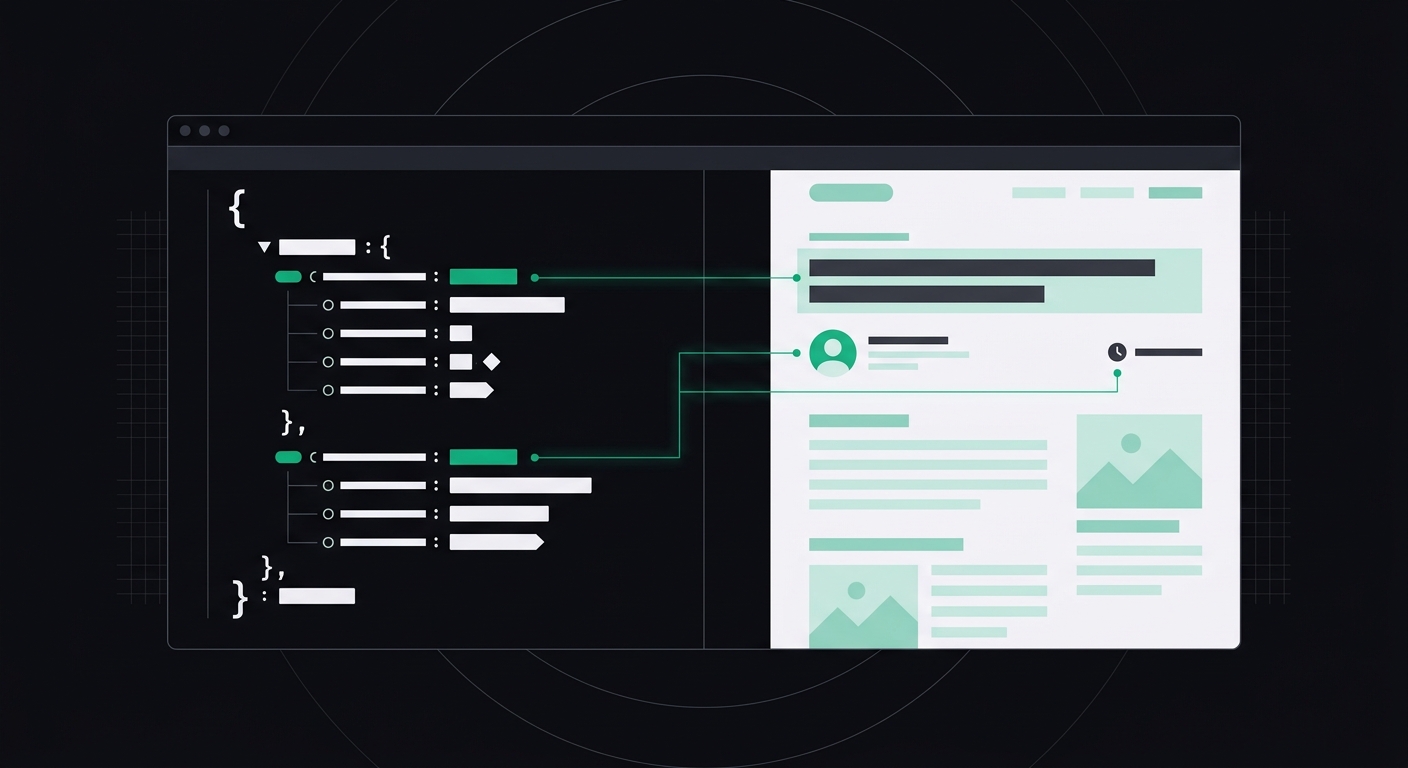
Structured data (usually written as JSON-LD) labels the parts of your page — this is the author, this is the price, this is the publish date, this is the question and its answer. Search engines have used this for over a decade to build rich results: star ratings, recipe cards, event listings.
AI engines use it a little differently. A crawler like GPTBot or PerplexityBot doesn't need schema to understand your content — large language models are pretty good at parsing plain HTML and inferring structure on their own. What schema does is remove ambiguity. It tells the model, with certainty, that a number is a price and not a phone number, or that a name is the author and not a random mention in the body copy. Think of it as a confidence booster for machines that are already 90% sure — schema gets them to 99%.
That distinction matters because it means schema markup can't rescue thin or poorly organized content. It can only clarify content that's already good. If you haven't looked at the broader picture of what makes a site legible to AI systems, the AI readability guide covers the three things that matter most — crawler access, a shared HTML core, and extractable structure. Schema sits inside that third pillar, but it's not the whole pillar.
Which schema types actually get your site cited by AI engines?
Not all 800-plus schema.org types are equal here. In my experience testing pages against ChatGPT Search and Perplexity, a short list keeps showing up in citations. Everything else is mostly noise for AI purposes, even if it's still useful for classic Google rich results.
Organization and WebSite schema
This is foundational, not flashy. Organization schema tells AI systems who you are, what your official name is, and how to connect your domain to a real entity — which matters a lot when a model is trying to decide whether to trust a source. WebSite schema, paired with a sameAs property linking to your verified social profiles, helps reinforce that you're a real business and not a content farm. I'd call this table-stakes rather than a citation trigger on its own, but skipping it makes everything else weaker.
Article and BlogPosting schema
For blog content, Article or BlogPosting schema marks up the headline, author, publish date, and modified date. AI Overviews and Perplexity both weight recency heavily — a 2023 stat about a fast-moving topic like AI crawling behavior is basically expired. Having a machine-readable dateModified field gives the engine an easy way to confirm your content is current, which is one of the more underrated reasons freshly updated pages outrank older, more "authoritative" ones in AI answers.
Product and Review schema
If you sell anything, this is probably your highest-leverage schema type. Product schema with price, availability, and aggregate rating gives AI shopping assistants and comparison-style AI Overviews something concrete to quote. I worked with a small outdoor gear retailer last year who added Product and Review schema across maybe 40 product pages — within two months, several of those pages started showing up in Perplexity's shopping-style answers with pricing pulled directly from the markup. Correlation, not proof, but the timing was hard to ignore.
HowTo and Recipe schema
These are step-based, and AI engines love step-based content because it's already chunked into extractable pieces. If your content naturally walks through a process — assembling something, fixing something, cooking something — HowTo schema mirrors the structure a model wants anyway. It's a case where schema and good writing point in the same direction.
FAQPage schema — worth less than it used to be
FAQPage schema still validates and still won't hurt you, but its influence has dropped. Google scaled back the rich-result display for FAQ schema in 2023, and most AI engines don't treat it as a special signal — they're just as likely to extract a well-written Q&A section with no markup at all. I've written more on this specifically in a post about whether FAQ schema still matters for AI answers, and the short version is: keep it for legacy SEO value, don't expect it to drive citations on its own.
BreadcrumbList schema
Smaller impact, but useful. It clarifies site hierarchy and helps a crawler understand where a page sits relative to the rest of your content — handy for large sites with deep category structures, less useful for a five-page small business site.
Does JSON-LD matter more than microdata for AI search?
Yes, and it's not close. JSON-LD is a single script block, usually dropped in the <head>, that describes the page without touching your visible HTML. Microdata and RDFa require adding attributes directly inside your content tags, which is messier to maintain and easier to break.
Google has recommended JSON-LD as its preferred format since around 2015, and every major AI crawler I've tested parses it without issue. There's really no reason to use the older formats on a new project. If you've inherited a site with microdata scattered through the templates, it's usually worth migrating — not urgent, but worth putting on the roadmap.
<script type="application/ld+json">
{
  "@context": "https://schema.org",
  "@type": "Article",
  "headline": "Which Schema Types Actually Get Your Site Cited by AI Search?",
  "author": {
    "@type": "Organization",
    "name": "AccessKnight"
  },
  "datePublished": "2025-01-15",
  "dateModified": "2025-06-02"
}
</script>
That's a minimal but functional Article block. Notice there's nothing exotic in it — just the fields a model actually uses to establish authorship and freshness.
How do I add JSON-LD without breaking my site?
Add it as a standalone script tag, validate it, and don't let it drift from the visible content. A few practical rules I follow on every site I touch:
- Match the schema to what's actually on the page. Marking a page as a Product when it's really a blog post about that product is the kind of mismatch that gets flagged by both Google's testing tools and, increasingly, by AI systems cross-checking claims against visible text.
- Keep dates current. An automated build process that updates
dateModifiedon real content changes (not just template tweaks) is worth the half hour it takes to set up. - Validate before you ship. Google's Rich Results Test and the Schema Markup Validator both catch syntax errors for free. Broken JSON-LD is often silently ignored by crawlers, which means you get zero benefit and don't even know it.
- Don't stack conflicting types on one page. Multiple Article blocks with different headlines confuse more than they clarify.
What matters more than schema markup for AI citations?
Plain, well-structured HTML content beats schema every time it's tested head to head. AI crawlers rely on your actual heading hierarchy, your paragraph structure, and your semantic tags — <article>, <section>, proper <h1> through <h3> nesting — far more than they rely on a JSON-LD block sitting off to the side. If your headings skip levels or your content is buried behind client-side JavaScript that never renders for a bot, no amount of schema fixes that. I've covered the mechanics of this in a post on structuring content for AI extraction, and it's the piece I'd point to before spending another hour on schema.org properties.
This is also where accessibility and AI readability genuinely overlap — not as a marketing angle, but as a technical fact. Semantic HTML built to meet WCAG success criteria (proper landmarks, meaningful heading order, descriptive link text) produces the exact document structure AI crawlers parse most reliably. When we run a free scan on a client site, we're checking both the 33 WCAG rules and the AI-readability layer in the same pass, because in practice, fixing one tends to fix the other.
Key Takeaways
- Organization, Article, and Product schema currently carry the most weight for AI citation behavior.
- FAQPage schema still validates but has lost most of its practical influence since 2023.
- JSON-LD is the format every major crawler expects — migrate away from microdata if you're still using it.
- Schema clarifies content that's already well-structured; it can't fix content that isn't.
- Semantic HTML and proper heading hierarchy influence AI extraction more than schema markup does.
Frequently Asked Questions
Does adding schema markup guarantee an AI citation?
No. Schema markup improves an AI crawler's confidence in interpreting your page, but it doesn't guarantee a citation. Citation decisions depend on content quality, freshness, authority signals, and whether the answer is stated clearly enough to lift and paraphrase.
Is FAQ schema still worth using in 2026?
It's still worth adding for legacy SEO reasons, but don't expect it to drive AI citations on its own. Google reduced its rich-result display for FAQ schema back in 2023, and most AI engines extract well-written Q&A sections whether or not they're marked up.
Which schema type should I prioritize first if I only have time for one?
Organization schema, followed closely by Article or Product schema depending on your site type. Organization schema establishes who you are, which underpins how much trust an AI engine places in everything else on the domain.
Do AI crawlers read JSON-LD the same way Google does?
Mostly, yes. Major AI crawlers parse standard schema.org JSON-LD without special handling, since it's a widely adopted, well-documented format. The bigger risk isn't format incompatibility — it's schema that's broken, mismatched to the page content, or blocked entirely by a misconfigured robots.txt.
Can structured data replace good content structure?
No. Structured data is a supplement, not a substitute. A page with flawless JSON-LD but a single wall of unbroken text, skipped heading levels, or JavaScript-rendered content that never reaches the crawler will still underperform a plainer page with clean semantic HTML.
Conclusion
If you're going to spend an afternoon on this, spend it in this order: get Organization schema on every page, add Article or Product schema where it fits, validate everything with Google's Rich Results Test, and then step back and look at your actual HTML structure — headings, semantic tags, whether your content even renders for a crawler that doesn't execute JavaScript. That last part is usually where the real gains are hiding. Run a free scan of your site and you'll see both sides of it at once: the WCAG issues and the AI-readability gaps that schema alone was never going to fix.
Check your website's accessibility
Scan against all 33 WCAG 2.1 rules and get code-level fix suggestions — free.
Run a free scan →